Tuesday, July 21, 2015

Summer time is Tomato time


One of the best things about the summer is the abundance of fresh vegetables. And for cooks, tomatoes are at the top of the list.

Several times during the summer I will make fresh tomato sauce mainly to freeze to have available during the winter. The number of dishes you can make that incorporate tomato sauce are as varied as your own imagination.

The ingredients for making the sauce are simple:

Olive oil, garlic, onions and lots of fresh basil. Oh yes....ripe tomatoes.

Let's start there first. I suggest using Roma tomatoes because they have a high "meat to juice" ratio.

This is three pounds of fresh Roma's I bought at Whole Foods to use for sauce.

Step number one is to sauté one onion chopped, 4 to six cloves of garlic, peeled but whole in around 4 or 5 tablespoons of olive oil. After the onions have sweated about 5 or 10 minutes, set the pan aside and peel the tomatoes.


To Grate or not to Grate.......


Now, I have done this two different ways. The first way is to score the tomatoes on both ends and drop them in boiling water for 5 minutes or so then run them under cold water. This will cause the tomato skin to peel back and make it much easier to remove. The other method is to simply cut the tomatoes in half and use the course side of a box grater to "grate" the tomatoes which will remove the meat and juice and leave the peel! Sounds easy and it is, but it also tends to leave you with too much juice (See the first picture above) and other then the time involved with boiling the tomatoes, is not much quicker. So I suggest boil the tomatoes then peel the skin off. With Roma tomatoes you simply cut off the tops and bottoms (with larger tomatoes you will have to core them) and lightly squeeze the tomato to remove most of the seeds and juice then add them to the pot with the onions and garlic. Squeeze the tomatoes in a bowl to preserve the fresh juice in case you need to add more liquid to the sauce.

Put the pan back on the stove and add as many basil leaves as you wish! For this batch of sauce, I used 10 basil leaves, chopped to help release their flavor. I also added a tablespoon each of chopped fresh oregano and thyme and two tablespoons of chopped fresh rosemary from my garden.

At this point you simply sauté the tomatoes with the onions and garlic until the tomatoes are "stewed" and limp around 15 to 20 minutes on medium heat.


Image result for breville immersion blender


Now, if you are like me you want your sauce to be smooth so I use my Breville immersion blender to make the sauce smooth and creamy. If you don't have one then using a traditional blender, though more trouble, it will do the trick.

Here is where you need to tasted the sauce to adjust seasoning by adding salt and fresh ground pepper. Sometimes I will add one or two tablespoons of tomato paste to give it a little body. You may want to add more herbs. Be careful with the salt! Add what you wish a little at a time and let it cook in and taste again. Remember you went to a lot of trouble to get this far to realize you have put in too much salt! (Done that).


Here is the finished product! Believe me it smells as good as it looks.

Now most of this I freeze but I did save enough to have for dinner. And I decided to serve it with pasta and shrimp....

The simple way would have been to simply add the peeled shrimp to the hot tomato sauce letting them cook in the sauce and serve it like a shrimp creole. That is a little to heavy for my taste this time so I sautéed the peeled shrimp for dinner for two:

2 dozen small/medium shrimp
2 tablespoons olive oil
2 tablespoons chopped green onions
1 tablespoon minced green pepper

Cook the pepper and the onions in the oil for a couple of minutes over medium heat then add the shrimp and cook until pink.

Spoon the warm tomato sauce on the cooked pasta and put the shrimp on top. Add fresh parmesan cheese and you are good to go!


What did I drink with that?

Well....you can go either way. The tomato sauce can handle red wine such as this Chianti on the left. The shrimp says white like the Burgundy on the right. So I split the difference with the Cotes du Provence Rose. Rose' wine says summer. Check out my earlier post on rose' wine.


Saturday, July 18, 2015

The best burgers are the ones you make yourself


So.....yesterday I decided I wanted a fresh burger for dinner. So the only way to do that is make the burger yourself.

First you need to decide what meat you want to use for the burger. There are plenty of different opinions on this and my favorite is boneless short ribs. Great combo of meat and fat. The store didn't have any so I went to the next best which I think is chuck roast.

Now.......we have all had bacon on a burger and we have all had onions on a burger but I think the best way is to COMBINE the bacon and onion right into the burger.

Why?

Well......flavors are always better when they are cooked in rather then simply placed on top!


So as I ground up the beef I ground up the bacon and added the onion as well so the finished product included all three.


You may notice that the mix is dropping into a bowl resting on ice. I got this tip from the internet to help keep the meat cold. It's a good idea as it helps when making the patties.

As the mixture is falling into the bowl, carefully mix it with your hands to insure the three elements are evenly folded in. Handling the meat too much makes the patties tough.

Here is the finished product.


Another tip I picked up is the press a hole in the top of the burger. This will keep the burger from "balling up" when you cook it which helps retain the juices.

Believe me.....cooking the bacon and onion in the burger tastes way better then slapping it on top!

So here is the deal:

  • Two or so pounds of whatever meat you choose be it sirloin, chuck roast, or my preferred boneless short ribs.
  • One pound of thick sliced hickory smoked bacon
  • One medium sweet onion (Vidalia is the best)

What am I drinking with that??


When most folks think of Beaujolais wine they think of the stuff that is sold around the holidays called Beaujolais Nouveau (also called vin primeur or first wine). It is usually from the lesser districts in the Beaujolais region and is typically only seven to nine weeks old. Like Thanksgiving, it is meant to be a celebratory wine to welcome in the new harvest. 

In 1985 the third Thursday in November was established as its release date which has become a cleverly hyped event here and around the world. The stuff is fun to drink and is usually gone within a month of its release and accounts for over one third of all the wine produced in Beaujolais.

Unfortunately it also overshadows the really good wines that are produced in Beaujolais.

Beaujolais wines are not considered to be nearly as "serious" as their cousins to the north (Burgundy) or their cousins to the south (Northern Rhone) They are lighter and fruitier.....more to be considered a Bistro wine which makes Beaujolais the perfect wine of choice for a burger!

There are three levels of Beaujolais with the best being the Cru wines. The term cru here does not indicate a vineyard as it does in other areas of France but refers to the ten villages in the appellation that have been given special recognition for their wine.
 (Note....the above information about Beaujolais comes from the great book by Karen MacNeil titled:
The Wine Bible.)

The wine we drank with the burgers is from Morgon one of the ten cru villages.

So that's it!

A great burger and a great wine for a perfect Friday night dinner!

So now what?


Too hot to play golf and so I got these great organic Roma's at Whole Foods so I'm making homemade tomato sauce this afternoon. If I get around to it I'll blog about that too.

Tuesday, March 18, 2014

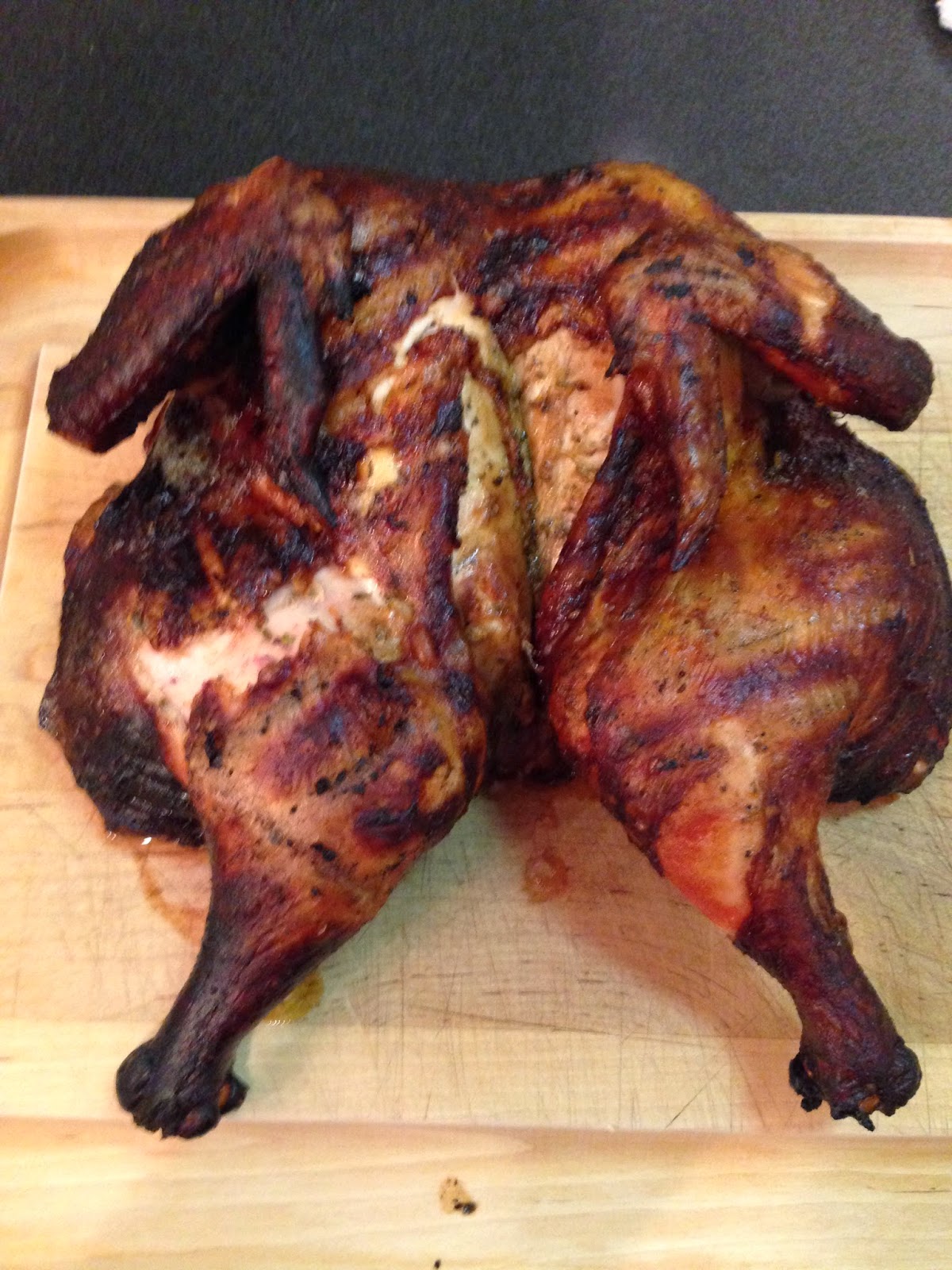
Whole Chicken on the Grill

Although it is 38 degrees here in Columbia, SC today, we have had enough warm weather that we start thinking about the grill.

I have always cooked chicken on the grill. Either marinated boneless breasts or thighs, or bone-in breasts with BBQ sauce but, until recently I never cooked a whole chicken on the grill. If you are like me, keep reading because you will get rave reviews on this way to grill chicken.

Two things that are a must to make this work:

1. Great quality whole chicken. Around here you would go to Earth Fare, Whole Foods or Trader Joe's.

2. A grill that you can control the temperature, preferably a charcoal grill and best yet an egg type grill. It doesn't have to be the Cadillac grill the Green Egg but these type grill called Kamado grills, are the best for providing great smoky flavor and easy to control temperature. The top end cookers can cost over $800.00. What I use is an Akorn Kamado Kooker made by Chhar-Griller. You can get one for under $400.00. http://www.hayneedle.com/product/chargrillerredakornkamadokookerwithoptionalcover.cfm

Okay....let's get started.

  • First, wash the chicken and pat dry with paper towels.
  • Place the chicken breast side down on a cutting board and with a good pair of scissors, cut the back bone out of the chicken. If you want, ask your butcher to do this when you buy the chicken.
  • When removed, turn the chicken over and press down on the breast bone to flatten the chicken out.
  • Now, the fun part. In a small bowl, mix 2/3 to 1/2 a cup of olive oil with two teaspoon's each of sage, oregano and chopped fresh rosemary. You may also add other herbs or spices that suit you. Carefully lift the skin up off the breasts and thighs and rub this mixture under the skin onto the meat.
    • This is all well and good BUT......here is what I prefer. Instead of olive oil, I use Duck Fat! The duck fat gives the chicken a much hardier flavor and adds a whole dimension to the grilling. If you can't find duck fat then go ahead with the olive oil or mix in a tablespoon of butter with the olive oil.
  • Once done, sprinkle the outside with fresh ground pepper and kosher salt. It will look something like this:
 

    Now this is a big yard bird......about 5 pounds, but you can see it is oozing duck fat and spices. I also sprinkled some Tony Chachere's Creole seasoning on top
     Original Creole Seasoning 8 oz.
     
     
    Let the chicken rest and come to room temperature while you light the grill.
     
    When the coals are ready, bring the temperature up to 350 degrees and hold it there.
     
  • Throw in a handful or two of wood chips. Now, I prefer apple wood to hickory. It is not as strong and won't overpower the chicken. I also don't soak them first as I don't want the wet chips to lower the temperature.
  • Now place the chicken on the grill Breast Side Down.
  • Close the grill top and leave it alone for 20 minutes. The combination of the smoke from the wood chips and the oil or fat dripping on the coals, creates a marvelous combination that browns the chicken.
  • After 20 minutes, open the top and carefully turn the chicken breast side UP. It should look like this:


You think this looks good you should smell it!!!
 
  • Now put the top down again, and let it cook for another 15 to 20 minutes or until the temp in the breast meat is 160 and the thigh is 175.
    • Now, here is another aside: the best meat thermometer I have found is made by ThermoWorks and called Thermapen: 
Thermapen Extended


Once cooked, take it off the grill, cover with foil and let it rest for ten minutes. Here it is ready for carving:


Folks, I will tell you that you will love the flavor. It is moist and all that fat and seasoning dripped off on the coals so it is not greasy at all.

What am I drinking with it??

The obvious choice with chicken is a white wine. But grilling the chicken gives it a hearty, smoky taste that can stand up to a red such as a Pinot Noir. If you have read my other posts, you know I like French wine so I would go with a Burgundy which is light enough not to over-power the chicken. But...the best summer wine for this chicken is rose'. I wrote a blog in May of 2011 about rose' so check it out.


Thursday, August 9, 2012

A SCALLOP DISH FOR THE SUMMER

SEA SCALLOPS with TOMATO CORN RELISH


I am a fan of scallops.

The problem is getting good scallops, and a reason for this is "wet" scallops versus "dry" scallops.

There is a difference between wet scallops and dry scallops. The difference is how they are preserved. Wet scallops which are what we most often find in American stores, are commonly treated with phosphates which are a preservative.  Besides having an effect on the taste, scallops soaked in this manner absorb water which, of course, is released when cooked making them harder to brown and smaller. Dry scallops are not treated with any chemicals.  They are harvested directly from the ocean, then immediately frozen. They are harder to find than wet scallops and are more expensive but are definitely worth the effort.

Served along with whole wheat orzo and fresh spinach, this meal is both easy and healthy. It is simple enough for a weeknight and (I think) elegant enough for company. My wife liked it not only because of the taste but she said it looked good on the plate!

First, the relish:

Two tablespoons of unsalted butter
Two ears of fresh, sweet corn (cut from the kolb)
Two cups of quartered cherry tomatoes
1/3 cup of fresh basil (chopped)
One tablespoon of cidar vinegar
One teaspoon of sugar
1/2 teaspoon of salt

Do this a couple of hours ahead of time if you can to allow the flavors to meld.

Melt the butter in a saute pan and cook the corn over medium heat until cooked and slightly brown (about 5 minutes). Add the tomatoes and saute for another two minutes. Remove from the heat and transfer to a glass bowl to cool. Once room temperature, I stirred in the basil, vinegar, sugar and salt. I covered the bowl and put it in the refrigerator. (By the way....this relish is also good with grilled chicken).

For the orzo, I used whole wheat orzo and cooked it by the directions on the container. When it was almost done, I add a bag of baby spinach and a pinch of garlic salt and let the spinach cook down as the rice was finishing cooking. Cover to keep warm.

Now for the scallops. This was not difficult as I threaded the scallops on skewers and cooked them on the grill. One trick I've learned is when grilling scallops either use a grill pan to "saute" the scallops on the grill or to thread two skewers through each scallop. This makes it much easier to turn the scallops on the grill.

Heat the grill to around 400 degrees. Dip a thick wad of paper towels in a bowl with cooking oil in it and liberally grease the grill to prevent the scallops from sticking.

Place the skewered scallops on the grill and baste with a simple mixture of melted butter and salt and pepper. Nothing fancy. Close the top, cook for about five minutes. Turn the scallops, baste again and cook for another five minutes. The scallops should be lightly browned and firm.

Plate the scallops and spoon the relish over them or on the side. Add the orzo and you have dinner!


What am I drinking with this?

Through my good friend at Aleph Wines, Jean Pierre Chambas, I have been enjoying several white burgundies produced by Maison Champy in the Cote de Beaune.


This Pernand-Vergelesses is produced in the commune of the same name and is notable for it's better known and much more expensive neighbors: Corton, Corton-Charlemagne and Charlemagne. It is a reasonable priced wine from the 2009 vintage that does nicely on its own but pairs beautifully with food.

So there you have it!!!

A summertime meal easy enough for a weeknight but elegant enough for weekend guests.


Friday, August 3, 2012

Beef Daube....to "glacée or not to glacée"

Think of a cold winter night with a roaring fire and the idea of a hearty beef daube over rice with crusty french bread to sop up the gravy brings a smile to my face.

Daube is a french word that, according to one dictionary definition is: "a stew of braised meat, vegetables, herbs, and spices."

Daube de Boeuf is a classic french dish. The beef is braised then slowly cooked in a heady concoction of vegetables, rich stock, wine and herbs.


The problem is, it's the middle of summer and the heat index is over 100 degrees and the idea of sitting down to a big ole bowl of beef stew is NOT that appealing. So......how to enjoy that wonderful flavor in a summer version?

Answer: Daube Glacée (pronounced Dobe Glah Say)

Often served in New Orleans as an hors d’oeuvres, Daube Glacée  is simply leftover daube that was cooked with spices and a stock which included veal bones and pigs feet. These are high in natural glycerin which when mixed with the daube and poured into a terrine, formed a solid jelly-like mass. This was either sliced and served as a cold meal or in smaller pieces as hors d’oeuvres.

I remember as a child my Aunt Louise would give a loaf of Daube Glacée to friends and family at Christmas. I can still picture my father sitting at the kitchen table, quite content, with a thick slide of Daube, a spoonful of mayonnaise and a pile of saltines.

A number of the older recipes for this dish include the pigs feet and so on but as a practical matter, unflavored gelatin does the trick.

The recipe I use comes from Chef John Besh of Restaurant August in New Orleans. His cookbook: My New Orleans, the cookbook should be a "must have" for any chef who loves New Orleans. More information can be found at www.chefjohnbesh.com


I'm not going to type the recipe here as it has a lot of ingredients but you can find it on Google and here is the link: http://books.google.com/books?id=L-PBWXgTTjsC&pg=PA344&lpg=PA344&dq=john+besh+beef+daube+glace&source=bl&ots=qNXE5mIFcc&sig=9c9zW_ALq6n3vxpudRbSTxkEqzM&hl=en&sa=X&ei=SDocUKOFDcfb0QHmpIHwAw&ved=0CGIQ6AEwAA#v=onepage&q=john%20besh%20beef%20daube%20glace&f=false

I followed the directions pretty closely. The dried mushrooms I used were chanterelle mushrooms. I keep a number of different dried mushrooms and I felt the chanterelle mushroom imparted a pleasant flavor without overpowering the dish. Incidentally, I buy all my dried mushrooms from Olive Nation. They have wonderful products besides the mushrooms. Here is a link: http://www.olivenation.com/Mushrooms-C52.aspx

The big hurdle with this recipe is the veal stock. Where I live, it is impossible to find in a grocery store. So I either have to order it, make it or fake it. My preference is to make it but try finding veal bones. A reasonable alternative is to use store bought demi-glace. The demi-glace is made with veal and when added to a combination of water and beef broth, it comes close. Candidly, I would simply suggest using beef broth. Some will argue with me but I think, especially for this recipe, it adds boldness to the dish.

Something else I take care with is the wine I use. I've written here before that the first rule about cooking with wine is if you wouldn't drink the wine, don't cook with it. This rule applies for any bottle you might already have open. Don't think "well I don't want to waste it so I'll stick it in the stew". If the wine has turned, and you don't enjoy drinking it, don't cook with it. However, all is NOT lost. Don't throw out this wine, save it in a ceramic vat for fabulous red wine vinegar.

I think this recipe calls for a big wine and that makes me gravitate to the Southern Rhone wines. I used a Cotes du Rhone (Guigal Cotes du Rhone 2007).

Something else that I did different was the cooking time. I started this around 5:30 one evening and around 8:00 that night, I let it cool and put it in the refrigerator. I took it out at lunch time the next day and let it simmer on very low heat until around 6:00 that night, stirring it periodically and adjusting seasoning.

Since I hadn't forgotten about those cold winter nights, I didn't make Daube Glacée out of all of it. I put a fair amount in the freezer for the winter.

That reminds me......here is another idea for this recipe: Beef and Barley soup. Somebody remind me later and I'll tell you how I use this as a basis for a great winter soup.

I took the rest of the daube and added the gelatin, let it cool and put it in the refrigerator.


So.....here it is!!!


A nice cold way to eat beef stew on a hot summer night.

How did I serve it? We had a slice of daube accompanied by cooked and chilled haricot verts along with a large dollop of homemade mayonnaise. Not bad.


And....guess what??? Don't like it cold? Hell....heat it up and it is Daube de Boeuf again!!


What did I pour with it??

This is clearly a red wine meal. So I picked one of the great wines from the Languedoc region of France: Mas de Gassac vintage 2000. The wine is a blend of Rhone and Bordeaux grapes and is outstanding.

Saturday, July 28, 2012

Kabobs Redux

In June of last year I posted a recipe for chicken kabobs cooked on the grill. (June 11, 2011)

I fixed them the other night for the first time in a while and I urge you to read it and try it. I think it is the best way to cook chicken kabobs period.

Also, I'll give one more plug for Cooks Illustrated. They have a fabulous web site with great recipes. It is not expensive and well worth it. Go to http://www.cooksillustrated.com/

So fire up the grill and open a bottle of crisp Cotes du Provence rose wine. You can thank me later.

Monday, July 23, 2012

Great Fish Recipe but......


Here in Columbia we are lucky to have a great Saturday market that is only a few minutes from our house. It is called the All Local Farmers Market and it is open Saturday from 9:00 to 12:00. Besides great fresh produce, they have a wonderful seafood vendor that come from Beaufort, SC. All the fish is local caught (except the scallops and salmon). Recently they have had a wonderful type of snapper called Hognose snapper. It is a mild all white fish that is delicious.

I bought a beautiful fillet on Saturday and was discussing with good friend and neighbor Joe Blanchard how we should fix it for Sunday dinner. A native of Tampa, there is a famous restaurant called Columbia that has a well known snapper dish called Snapper Alicante.

I'm not going to copy the recipe here as you can grab it on the Internet by simply googling snapper alicante. Although the recipe calls for red snapper and I had the milder cousin, it still worked great.

However!!!!

There is one hitch. The Columbia Restaurant cookbook calls for using 1/2 cup of brown sauce. The web site recipe calls for brown beef stock gravy. Now.....I know what brown sauce is but I'm not sure what brown beef stock gravy is. I'm assuming like you, it is some kind of beef gravy you conjure up using beef stock.

I don't care.......don't do it......please use brown sauce!! This is what makes this dish great!

The reason you want the brown sauce is the flavors are so much more complex then simple gravy. The problem is finding it. Brown Sauce is one of the "mother sauces" of french cuisine and is the base for a number of highly refined french sauces such as Marchand de Vin. You can find it online or find it at local gourmet shops. However, it is NOT hard to make and it FREEZES beautifully.

In previous posts, I've mentioned the Plantation Cookbook from the New Orleans Junior League. First published in 1972, it is still one of my go to cookbooks even though half of it is about Louisiana plantations. It is their recipe I use to make my Brown Sauce

You can buy the book at Amazon and other places but I hope you will buy it from Garden District Book shop in New Orleans. This great local institution picked up publishing the book when it went out of print. So if you want it.....please buy it from them: http://www.gardendistrictbookshop.com/

Regardless of whether you use this recipe or not, you are doing yourself and this dish a disservice if you opt for gravy over the brown sauce.

It is inspired. How many different ways could you think to poach fish before you would think of using a beef based sauce?


So here it is.....served with blanched asparagus sauteed in olive oil and tarragon. We also had a salad of heirloom tomatoes and avocado.

The fish, poached in the brown sauce mixed with a white spanish wine (albarino) on a bed of onions and topped with red and green peppers was simply fabulous. Make sure you have some good crusty bread to mop up the sauce!


What did we drink with it??

Even though we cook it in a beef based sauce, the dish is way to delicate for a red wine. Joe brought a 1992 rioja and it was still too big a wine for the meal.

I came to the rescue with a 2006 Grand Cru Cablis from Simonnet Febvre that worked just great.

On a personal note......in my first post in May of last year, I told you all that my mother was a great cook and the person who inspired me to cook. Over the years we continued to share recipes and when I would visit her in New Orleans, I always cooked for her getting a loving dose of "critique" on the side.

My mother passed away almost two months ago in May. She was 86. Her cookbooks are crammed with personal notes and marked through with changes to recipes. I've got a lot of cooking to do to get through them.

I never fixed this recipe for her. She would have loved it.

So here is a "tip of the glass" to my mother, Sue Menge. She was a real character and a hell of a cook!


Sue Menge
1925-2012

Wednesday, January 25, 2012

Chicken Pilau that won't "Bog" you down

A famous South Carolina Low Country dish is Chicken Pilau or Chicken Bog. It tends to be a gooey concoction of mainly chicken and rice usually with sausage and onions sauteed in bacon fat etc. It is the kind of meal that brings a smile to Paula Dean's face.

Now, no one is every going to accuse me of being Mr. Heart Healthy but I fixed a kinder,gentler version of a Rice Pilau that turned out pretty good.

This will feed four:

One small head of broccoli: just florets
Two cups (loosely packed) dried Chanterelle mushrooms
1/2 bell pepper chopped
One small onion chopped
One bay leaf
Two boneless chicken breasts
Two packs of Success Brown Rice

Take the broccoli and cook in boiling water until soft. Remove the broccoli from the water and put under cold water to stop the cooking. Do not throw the water away! While the broccoli is cooking, heat two/three cups of water in a measuring cup to almost boiling and add the Chanterelle mushrooms. Note: I buy my dried mushrooms at www.olivenation.com I have been buying stuff from them for years and I recommend them highly. Let the mushrooms reconstitute in the water (about 15 to 20 minutes). Remove the mushrooms from the water and pour the remaining mushroom stock into the pot of reserved broccoli stock.

Put one tablespoon of olive oil in a saute pan and brown the two chicken breast over medium-high heat. Once browned on both sides, remove the pan from the heat, take the chicken and coarsely chop and return to the pan. Add 1/4 teaspoon of salt and a teaspoon of fresh ground pepper. Return the pan to the stove and stir the chopped chicken over medium heat until cooked. Add a 1/4 cup of dry white wine to deglaze the pan and continue to cook until almost dry. Set the chicken aside.

Now....in a 12 inch skillet, heat two or three tablespoons of chicken fat.

What????? Did he say chicken fat?????

I have made it a practice of saving the fat whenever I cook some kind of beef or poultry. Beef, lamb, chicken, turkey whatever. I pour off the fat and freeze it.

If you are like most people, you don't have chicken fat in the fridge so simply use butter but IN THE FUTURE.......start saving your fat!

When the fat has melted, saute the onions, bell pepper and bay leaf over low heat for 15 to 20 minutes. This gives the bay leaf time to sweat and add flavor. Don't brown the onions.

While doing this, boil the reserved stock and cook the rice. (If there is not enough stock to cook the rice, add chicken broth).

While the rice is cooking, coarsely chop the mushrooms and add to the saute pan continuing to cook over low heat.

When the rice is cooked (10 minutes) remove from the water and drain.

Coarsely chop the broccoli and add it to the pan then add the chicken and then add the rice. (Don't simply dump both bags of rice....you may not want all that rice so dump the first bag and add as much of the second bag as you wish).

That's it!! Stir it and serve it!

Chicken Pilau purists will say this isn't Chicken Pilau and they will probably be right. It if makes you feel better, cook a bunch of bacon and saute the vegetables in the bacon grease and chop up the bacon and throw it in at the end with the rice and chicken.

Another alternative is to add some smoked sausage but now we are getting back to Paula Dean territory.

Try it my way.....no bacon or sausage. I think you will like it. Plus with brown rice and broccoli, you won't feel the need to go out and do something stupid like jog or work out.

What do I drink with this??

A lighter red wine such as Pinot Noir will stand up to this nicely. Most folks will want a white and if you have read my previous posts you know I abhor the nasty domestic chardonnays and think most pinot grigio is tasteless. So go with a white burgundy, whatever you can afford. But for a different taste, I would try a nice quality champagne.....I think you will be pleased with the match.


Friday, August 26, 2011

Grilled Shrimp

To Peel or not to peel......that is the question


Grilling shrimp is a great summertime alternative to more conventional ways of fixing our favorite crustacean.

The problem is that it is easy to end up with something tough and chewy. Here is an idea that may seem like too much work but it will yield you a more tender shrimp dinner.

First, use only large or jumbo shrimp, split the shell down the back and remove the vein. Then put the shrimp on not one but two skewers close together which will make it easier to turn on the grill. Depending on what else you are having, figure on 5 to 6 shrimp per person.

While the grill is getting hot, melt 1 1/2 sticks of unsalted butter in a pan and add the juice from one large lemon and a teaspoon of caraway seeds and a dash or two of Worcestershire sauce. Let this simmer for a few minutes. Reserve half of the butter sauce for later.

Put the shrimp on the grill over medium heat and bast with the butter sauce. As the sauce drips down the smoke will help give the shrimp a great flavor. Cook until just turning pink and turn the shrimp over. Baste again and cook until the shells are slightly brown and the shrimp is pink.

To serve you have a choice: In the shells or peeled; warm off the grill or cold. Personally, I'd serve them in the shell right off the grill and let your guests peel them and pass the reserved butter sauce for dipping. Match it up with sliced tomatoes and homemade mayonnaise and hot french bread and you have a great summertime meal!

By the way......this works great with scallops too.


What am I drinking with this??

This dish cries out for a crisp cool Cotes du Provence rose'. I suggest the Domaine Houchart produced by Jerome Quiot on his wife's estate near Aix. Make sure you get the cuvee Sainte Victoire.

Sunday, July 17, 2011

Good Wine, Good Food, Good Friends on Saturday night


Shrimp in Champagne Reduction with Green Rice and
Molten Chocolate Souffle


We were having close friends Joe and Melissa Blanchard for dinner on Saturday. Karen had been to Charleston and went to Magwood's Seafood in Mt Pleasant and brought home fresh shrimp so the main course was set.

Note:
If you want to buy only fresh caught shrimp then Magwood Seafood is the best around. Located on Shem Creek in Mt Pleasant, SC, the address is 100 Haddrell St. and the phone number is 843.884.3352.

Joe likes rice (it is one of the few things he can cook since all he has to do is boil water and stick a bag of rice in it). So rice was going to be the starch, but since I wasn't making a creole sauce I wanted to make sure I had a rice recipe that was rich and would not be dried out.

A dessert I haven't fixed in a while is a rich chocolate souffle that used to be a staple on the menu at Commander's Palace in New Orleans. It is not complicated to make but be warned......it is heart-stoppingly rich.

As I mentioned in my earlier post about shrimp, when I peel the shrimp I save the peels and use them to make shrimp stock. The stock can be used for a variety of purposes but  in this case, I use the stock to cook the rice:

Green Rice
Take four cups of shrimp stock and bring to a boil. Add two cups of basmati rice and two bay leaves then reduce to a simmer, cover and cook for around twenty minutes.
While the rice is cooking, melt a stick of butter (yes a whole stick...this is nothin.....wait until you get to the dessert!) in the sauce pan. With the butter add:
1/2 cup of green onion
1 can of artichoke hearts (canned in water not oil) drained and chopped coarsely
1/2 cup of diced green bell pepper
1 cup of diced celery
1/2 cup of chopped parsley
1 bag of baby leaf spinach, roughly chopped,stems removed and washed.

Simmer slowly until the spinach is cooked down. By this time the rice should be cooked.

In a casserole dish, combine the rice and sauteed vegetables, cover with tin foil and set aside.


Now let's prepare the dessert

Molten Chocolate Souffle

Soften 1 1/2 sticks of butter. Take two tablespoons and liberally grease six ramekins that hold six ounces.
Take the remaining butter and 1 pound of good quality semi-sweet chocolate, chopped; into to the top of a double boiler over simmering water to melt stirring periodically.
In a food processor, crack 8 eggs. Mix together the eggs and 1 1/2 cup of sugar until smooth. Add the blended butter and chocolate mixer to the food processor and blend with the egg/sugar mixer for three minutes. Add 1 1/2 cups of flour and blend for another three minutes. Pour the mixture into the six ramekins, place on a cookie sheet, cover with wax paper and set aside.

OK, let's get ready to cook the shrimp and eat.

Shrimp in Champagne Reduction

In a large saute pan, put 3 tablespoons of olive olive oil. Add 4 or 5 thin slices of fresh ginger. Heat the olive oil over a low fire and and gently "sweat" the ginger for 5 minutes or so to infuse the ginger into the olive oil. Add the shrimp and continue to saute over low heat until the shrimp  are barely pink. Be careful not to have too hot a fire or cook the shrimp too long or they will be tough.

Remove the shrimp and ginger from the oil, and add to the pan:
1/2 cup of chopped green onion
1/2 cup of chopped red bell pepper
1 tablespoon of mince shallots
2 tablespoons of chopped parsley

Saute until the vegetables are cooked, about 3 minutes. Add three cups of champagne. Increase the heat until the champagne is simmering briskly. Reduce the champagne to about 2 cups. Turn of the burner and add the shrimp to the pan. Then add two tablespoons of cold butter and stir in to incorporate into the liquid to make a sauce.


Remove the rice from the oven and put a serving of rice in the middle of the dinner plate and top with a serving of the shrimp and serve.


While eating the shrimp, place the baking sheet with the souffles in the oven at 350 degrees. Let them cook while eating the main course. Check after 30 minutes. When the souffles are puffed and a toothpick can be inserted and removed cleanly, remove from the oven.


 Carefully invert a ramekin over a desert plate and remove the souffle from the ramekin onto the plate. Sprinkle with powdered sugar and serve. The outside will be nicely baked and the inside should be a gooey, "molten" chocolate.


What am I pouring with this?


We started with a vintage 2003 rose' champagne from Pommery. That was my offerring.

Now Joe has an excellent cellar which includes a diverse selection of white wines. He selected three very different French whites: one from Alsace, one from the Northern Rhone Valley and one from Bordeaux.

The clear winner was the Laville Haut-Brion from Bordeaux. The Alsatian wine and the Condrieu from the Rhone were too sweet for the dish although excellent representatives of their Appelations.

Since most of us don't have access to these kinds of wine, I would suggest, as always, anything that doesn't over-power the food. That immediately rules out California Chardonnay which, as those of you who know me, know I consider the worst wine bottled. Look for a sauvignon blanc from France or South America. From South America,  look for the wines from the Mendoza region of Argentina. There is a Spanish white made from the Albarino grape which would also go nicely with the shrimp. The Spanish wines are reasonably priced and quite good.
The wines from Spain and Argentina aren't easy to fine but are worth looking for. If you are local, check with Bryan at the Gourmet Shop.


Sunday, July 3, 2011

Cookies for the 4th

I don't bake.....well....not much. It's not really a guy thing but the main reason is I'm not very good at it. (Now ask me to make a porcini sauce with a Marsalla reduction for veal like I did last night and your on).

 I made french bread once that alternated from perfect to something with the consistency of rebar. I make cheese straws from time to time that are never as good as everybody else's.

But Karen has a few traditional items she bakes at holidays and these 4th of July cookies are one she and her buddy Bitsey have been doing for years

It takes a little time but it is worth it.:


Watermelon Cookies

2/3 cups butter softened(5 1/2 Tbsp)
2/3 cups shortening, softened
1/2 cup sugar
2 eggs
2 Tbsp milk
2 tsp vanilla
4 cups plain flour
3 tsp baking powder
1 tsp salt
Red paste food coloring
2/3 cup semi sweet mini morsels
3 cups powdered sugar
4 Tbsp water
Green paste food coloring

Beat butter and shortening in a large bowl until it is blended well. Gradually add sugar - mix well. Stir in eggs, milk and vanilla. Combine dry ingredients and slowly add to the other mixture. Add red paste and mix well. Put in a smaller bow, cover, chill well (at least three hour or overnight). On floured wax paper, roll out a portion of the dough to 1/4 thickness. Cut with round cookie cutter, then cut in half. Put on ungreased cookie sheet, put chocolate chips in the middle as "seeds". Bake at 375 for 8-10 minutes. Do not brown. Cool on a wire rack.


Combine green paste, water and powdered sugar. Dip rounded edge of cookie in this mixture and let dry on wax paper. Store with wax paper between layers. This will freeze well. (Makes approximately 110 cookies).


Friday, July 1, 2011

Cooking with Wine

I haven't met too many dishes that I prepare that I don't think are better after I add wine.
The question is, when the recipe says: "And add wine"......what kind of wine do you add? Is it OK to just grab whatever is open in the fridge?

If all else fails, follow the one golden rule: "If you wouldn't drink it.....don't cook with it".

Now assuming you don't keep wine around that you wouldn't drink, let's talk about which wines are better for cooking.

Domestic Chardonnay

Probably the one white wine most Americans drink and probably the worst wine to cook with. The intense oaky flavor of these wines rarely will add to the flavor of food. So even if you like drinking the stuff, I would not recommend cooking with it.

Pinot Grigio

Next to chardonnay, pinot grigio is the most popular white wine consumed in America. The wine is so light in taste that it doesn't hurt to cook with it but, in my opinion, it doesn't add anything either.

Savignon Blanc

This popular white is produced world-wide and has a pleasing citrusy taste. Non-oakie it does not change the taste of food like the domestic chards but does have a distinct taste unlike the pinot grigio. So of the "big three" I give the nod to savignon blanc with one major proviso: I wouldn't cook with the popular savignon blanc wines from New Zealand. They have a much stronger "grassy" taste then their cousins from France or from the U.S.

What about red wines?

Reds don't seem to have the same differing effect on food as do whites. But because of the strength of the taste, be careful as to how much you use.

What about other wines?

I suggest you try something different from whites or reds such as sherry, port and even champagne.  I have found champagne is a zippy alternative to white wines.....must be the bubbles. Try it and I think you will like it.

Port and sherry are fortified wines that have very rich flavors. They can both add a lot to food but can also overwhelm food. If you use sherry, use a medium bodied sherry like an Oloroso. Stay away from the sweet stuff.

Here are some suggestions for cooking with wine.

Try this with chicken:
Melt a tablespoon or so of butter in a sauce pan and add a package of chicken tenders. Cook over medium/high heat until browned and cooked through. Remove the chicken from the pan. Add a half of a thinly sliced onion and saute until starting to brown. The bottom of the pan should be dark brown from the chicken and the onions. Once the onions are browned, had a cup of white wine to the pan stirring and scraping up the brown bits from the bottom of the pan. Continue to cook until the wine is reduced by half. Remove the pan from the heat and stir in one tablespoon of cold butter. This will thicken the sauce and give it a velvety texture. Spoon the sauce over the chicken and serve.

There are a number of variations to this basic sauce. Sometimes I will use champagne. Sometimes I'll add flour, make a roux, and add chicken broth and cook it down to make a rich gravy. Sometimes I'll use sherry. The Oloroso I mentioned earlier can give the sauce a pleasant nutty taste.

Oh yeah.....here is another idea. Brown some butter in a sauce pan (be careful not to burn it). In a separate pan poach a fillet of fish like flounder or tilapia in champagne (see my post about bubbles for non-champagne ideas). Spoon the butter over the fish and serve with lemon wedges and capers. It will eat.

What would I pour with that?

Any bold tasting white will overpower the fish. A white Bordeaux will go nicely or try one of the white Burgundies from Macon. They are inexpensive and no oak.

Wednesday, June 15, 2011

My Favorite Dessert (Bread Pudding)

Monday was daughter Susan's birthday. When I asked her what she wanted for her birthday dinner the first thing she said was Bread Pudding.

I have a lot of "oldie but goodies" but bread pudding is the most requested. It is not hard to make since it is basically custard and french bread but I rarely see it in a restaurant outside of New Orleans and I don't know any other home chefs that make it so.......here it is:

French Bread Pudding with Rum Sauce

One cup of sugar
8 tablespoons of butter, softened
5 eggs, room temperature, beaten
1 pint heavy cream
dash (or two) cinnamon
1 tablespoon (or more) vanilla extract
1/4 cup raisins
One loaf of French bread cut into 1 inch thick slices

Pre heat the oven to 350 degrees

In a Kitchenaid mixer with the paddle blade, cream together the butter and sugar. Add eggs, cream, cinnamon, vanilla, and raisins mixing well.

HINT: Don't let the cream be too cold when you add it to the eggs and sugar. It will cause the butter to clot and make for an uneven custard. And don't think you need a big ole Kitchenaid stand mixer to make this....it is just easier to use than a hand mixer.

Arrange the bread in an oven proof dish, glass, pottery whatever. You should have about 12 pieces of bread. Don't cram them in, they should fit loosely.

Important: Always use french bread!!! Stale bread is even better (how do you think those cunning Creoles came up with the recipe to begin with).

Pour the custard over the bread lifting the corners slightly for the custard to fill in between the pieces. Let it stand for 5 or 10 minutes then without breaking the bread, turn the pieces over to make sure as much of the custard as possible soaks into the bread.

Set the dish in a larger baking pan:

You can see from the picture that the custard hasn't soaked all the way through which is fine. Place this into the oven and then fill the pan 1/2 inch or so from the top with HOT water. This water bath, will prevent the custard from burning while it is cooking.

Cover with foil and bake for 45-50 minutes uncovering the pan for the last 10 minutes or so to let the bread brown slightly.

Carefully remove from the oven (try not to pour the hot water all down your pants). It will (hopefully, no guarantee) look like this:


The custard should be soft, not runny but not hard.

While the pudding is cooking, you can make the rum sauce or, if you prefer, you could have made it earlier.

Rum Sauce

1 cup of sugar
2 1/4 cups of water
1 cinnamon stick or 1 teaspoon ground cinnamon
1 tablespoon unsalted butter
1/2 teaspoon cornstarch
1 tablespoon of dark rum

In a small glass or dish, mix 1/4 cup of water and cornstarch and put aside. In a medium saucepan, combine the sugar, 2 cups of water, cinnamon, and butter. Bring to a boil. Stir in the cornstarch and water mixture. Simmer stirring occasionally until the sauce is clear. Remove from the heat and add the rum. The sauce will be very thin.

Serve the pudding on a plate or in a shallow bowl and pass the rum sauce.


As a wise man once said...."It eats pretty good".

If you figure two pieces per serving, the recipe will serve 6. If you have leftovers then congratulations. It will last in the refrigerator for several days. When you serve it again, don't heat the pudding just heat up the rum sauce and pour the hot sauce over the pudding.

What am I pouring with this?

Well, this dessert is tailor made for a sweet dessert wine. The most famous, of course, is Sauterne which is made from the Semillion grape in the Bordeaux region of France. These wines can be quite expensive although delicious. The other grape variety that is used a lot for sweet wine is Muscat. Dessert wine from Muscat is produced in Provence in the village of Beaumes de Venise and in Languedoc around the village of Rivesaltes. 

These muscat wines are a little earthier than their Bordeaux cousins and a little sweeter but much cheaper.

I give the nod to the muscat wines from Rivesaltes. They are not quite as heavy as the wines from Beaumes de Venise.

These wines can also age very nicely too. What I opened was a 1999!

The Domaine Cazes is distributed by Master Wine Guy Jean Pierre Chambas with Aleph Wines.

If you want the wine check with Bryan at the Gourmet Shop: 803.799.3705